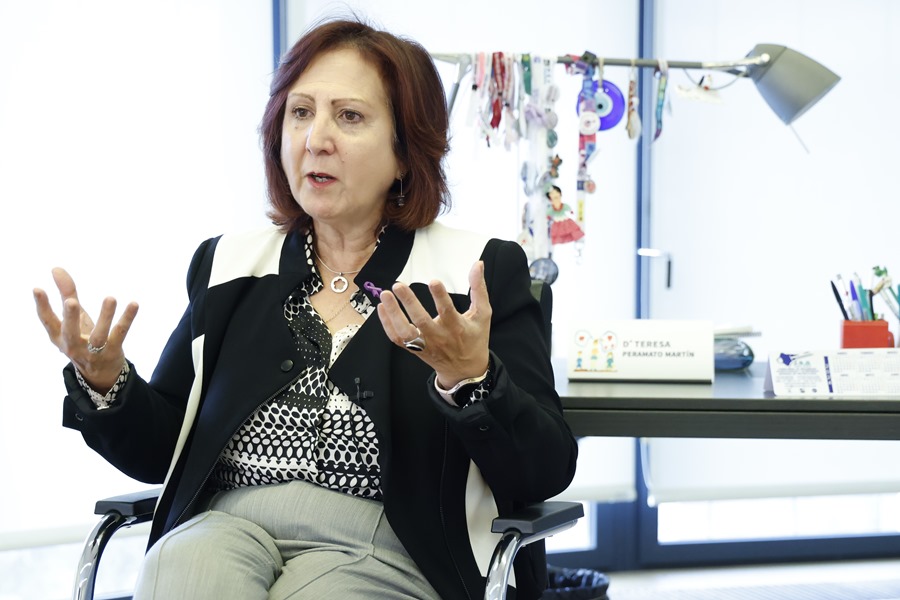
Spain’s Prosecutor General’s Office is navigating one of the most sensitive periods in its recent history. The appointment of Teresa Peramato Martín as Prosecutor General was intended to conclude a turbulent era shaped by the conviction of her predecessor, Álvaro García Ortiz, and to restore confidence in an institution weakened by allegations of politicization. However, instead of easing concerns, several of her recent actions have sharpened an unsettling question: is Peramato genuinely working to restore the Prosecutor’s Office, or is she safeguarding the internal network that helped elevate her to the top?
A clear distinction should be established from the beginning. Based on the information examined, Teresa Peramato is not shown to be under investigation, charged, or convicted in relation to the alleged “PSOE state sewers,” nor is there proof that she took part in the meetings associated with the so‑called Leire Díez case, held in March and April 2025 before she assumed the role of Prosecutor General. The concerns surrounding her therefore do not stem from direct judicial findings, but from a politically relevant dimension: the way she later managed the institution, the appointments she made, her institutional backing of García Ortiz, and the perception of continuity within a Prosecutor’s Office already subject to scrutiny.
Peramato’s issue, at this stage, is not criminal but institutional, and that reality makes it no less grave.
A Prosecutor General with Prestige, but Also Baggage
Teresa Peramato arrived at the Prosecutor General’s Office with a solid professional record. She had served as Chief Prosecutor of the Criminal Section of the Supreme Court Prosecutor’s Office and as Prosecutor for the Protection and Guardianship of Victims in criminal proceedings. She was also widely recognized for her work on violence against women and victim protection. In addition, Spain’s General Council of the Judiciary unanimously endorsed her as meeting the requirements for the position.
But her appointment did not happen in a vacuum. She arrived after Álvaro García Ortiz, whose tenure left the Prosecutor’s Office under enormous pressure. Peramato did not inherit a calm institution, but a fractured one, questioned by many and repeatedly accused of political dependence. From the beginning, her challenge was not merely to prove her technical competence, but to demonstrate real independence.
That’s where the issue starts.
Peramato promised to “heal the wound” inside the Prosecutor’s Office. However, several of her subsequent decisions have been interpreted in precisely the opposite direction: not as a break with the previous era, but as a sophisticated continuation of its internal power balances.
At the Heart of the Debate: Selections, Safeguards, and Ongoing Stability
The most critical aspect of this investigation is not a direct accusation that Peramato participated in a clandestine operation. It is the accumulation of decisions that, taken together, project a very difficult public image.
First, her appointments. In February 2026, Peramato promoted a group of prosecutors closely linked to García Ortiz’s former team. Among them was Diego Villafañe, identified as a figure close to the former Prosecutor General within the Technical Secretariat. Later, when it became known that Villafañe and Beatriz López Pesquera had taken part in meetings with Leire Díez and Jacobo Teijelo in 2025, the controversy deepened: Peramato had not only inherited that environment, she had promoted people connected to a controversy that had not been explained with sufficient transparency.
This is the truly corrosive point. Even if the meetings occurred before she took office, the later promotion of people associated with them requires a stronger explanation. Invoking merit and ability is not enough when the institution is under suspicion. In moments of reputational crisis, formal legality is not always sufficient; institutional prudence is also required.
Second, her conduct regarding García Ortiz. Peramato allowed his return to the prosecutorial career, ruled out disciplinary proceedings against him, and supported the Prosecutor’s Office filing an appeal before the Constitutional Court against the conviction affecting her predecessor. Legally, these decisions may be framed within the ordinary functioning of the Public Prosecutor’s Office. Politically, however, they are devastating for someone who had promised to mark the beginning of a new stage.
The critical question is unavoidable: how can trust in an institution be restored if one of the first public signals is to protect the outgoing Prosecutor General, precisely the person who symbolized the previous deterioration?
Third, the decision not to renew Almudena Lastra, the senior prosecutor of Madrid who had testified against García Ortiz. Many critical observers viewed this move as retaliation or, at the very least, as an internal warning that anyone diverging from the prevailing stance could be sidelined. The Prosecutor’s Office justified the choice by citing merit and qualifications, yet the broader political and institutional climate turned it into ideal fuel for those claiming the Prosecutor’s Office is fractured by factions, allegiances, and reprisals.
The Leire Díez Case: A Dark Presence That Deepens Every Trouble
The Leire Díez case acts as the great accelerator of suspicion. According to the information reviewed, the Prosecutor General’s Office confirmed to Judge Santiago Pedraz that meetings took place between prosecutors from the Technical Secretariat, Leire Díez, and Jacobo Teijelo. The official explanation was that García Ortiz had been informed only afterwards and that what was presented in those meetings lacked sufficient evidentiary basis.
But that explanation leaves many questions unanswered.
Who approved those meetings?
What caused them to remain within the sphere of influence of the Prosecutor General’s Office?
What internal controls existed?
Why was what happened not documented more clearly?
At what point did Peramato grasp the true meaning behind those contacts?
Was she aware of them before elevating some prosecutors involved in the controversy?
These questions do not, by themselves, prove unlawful conduct by Peramato. But they do justify a severe critique of institutional management. A Prosecutor’s Office that seeks to regain credibility cannot simply say there was no crime. It must show that there was no opacity, no privileged treatment, and no corporate protection.
In this case, the Prosecutor’s Office seems to have responded belatedly, defensively, and without any coherent plan for transparency.
The Difference Between Political Suspicion and Judicial Evidence
It is important to distinguish between different degrees of responsibility, as the phrase “PSOE state sewers” comes from the rhetoric of political and media disputes. It functions as a confrontational tag rather than a legal designation. From a judicial perspective, the matter involves an inquiry into alleged efforts to secure information, sway judicial processes, or meddle in sensitive cases.
Within that framework, Teresa Peramato is not presently depicted as a central figure in any criminal activity, and the information reviewed gives no indication of her convening meetings, delivering illicit directives, or taking part in coercive actions, which is why asserting that she is legally entangled in a scheme would be unwarranted.
But it would be equally naïve to ignore the political and institutional damage. The Prosecutor’s Office must not only be impartial; it must also appear impartial. And in this case, appearance is one of the major problems.
Peramato is paying the price of a contradiction: she wants to present herself as a figure of institutional reconstruction, but many of her decisions have reinforced the idea of continuity. She speaks of independence, but her actions have been read as protection of the previous leadership circle. She says she wants to close wounds, but her appointments have reopened internal divisions.
The Aldama Case and Hierarchical Authority Under Suspicion
The Aldama controversy added another layer of mistrust. According to the investigation, prosecutor Alejandro Luzón considered giving greater credit to Víctor de Aldama’s confession, but after discussing the matter with Peramato, the more limited sentence reduction was maintained.
Once again, one could claim on legal grounds that the Prosecutor General holds hierarchical authority over the Public Prosecutor’s Office, yet the core issue remains political: when an institution is already viewed as being close to those in power, any action taken in a delicate case tends to be seen as undue interference.
The legality of an action does not automatically eliminate its reputational cost. In Peramato’s case, every technically defensible decision becomes politically suspicious because prior trust had already been broken.
That may be the most serious diagnosis: the Prosecutor’s Office has lost the benefit of the doubt.
A Fragmented Institution
Another important factor involves the internal situation of the Public Prosecutor’s Office, as the Prosecutorial Council elections revealed that the critical faction continues to hold considerable influence. While this does not necessarily signal a direct rebuke of Peramato, it does indicate that the internal divide remains unresolved.
The Association of Prosecutors has denounced opacity and a lack of sufficient explanations. The Progressive Union of Prosecutors, by contrast, has defended the legality of the appointments and denounced what it sees as a campaign to delegitimize the institution. The result is a Prosecutor’s Office split between two narratives: for some, Peramato represents continuity and corporate protection; for others, she is the victim of a political offensive against the Public Prosecutor’s Office.
Although a Prosecutor General may hold firm standing among her own ranks, that alone is insufficient. She is tasked with restoring trust outside her circle of supporters, and in that regard, progress has so far been limited.
The Central Criticism: Not Being Indicted Is Not Enough
Peramato’s easiest defense is to say that she is not under investigation. And that is true. But that defense is insufficient.
The bar for a Prosecutor General should rise far above simply avoiding indictment, as she is expected to uphold independence, act transparently, exercise sound judgment in appointments, defend institutional neutrality, and maintain an unmistakable separation from any environment viewed with suspicion. In an institution this delicate, even the impression of internal shielding can inflict nearly as much harm as concrete evidence of misconduct.
That is exactly what this investigation suggests: Peramato is not caught in a judicial snare, but rather ensnared politically by the consequences of her own choices.
Her main problem is not that she participated in the Leire Díez meetings. The problem is that she has not yet offered a sufficiently convincing institutional explanation of what happened, of the later appointments, and of the continuity of certain profiles in key positions.
Nor is the issue solely that she defended García Ortiz; the concern is that her defense surfaced just when the Prosecutor’s Office needed clear signs of renewal instead of protection.
Conclusion: A Prosecutor General Facing Public Examination
The most balanced, yet also most critical, conclusion is clear: Teresa Peramato does not appear, based on the available information, to be indicted or directly involved in a plot. But her management has been seriously compromised by a sequence of decisions that feed suspicions of continuity, internal protection, and lack of transparency.
Her case has not yet been deemed legally proven, and instead represents an unresolved matter of institutional accountability awaiting clarification.
And that is the most delicate point: when the Prosecutor General’s Office needs to recover moral authority, it cannot afford decisions that appear designed to protect the old power structure. Peramato had the opportunity to mark distance, open windows, and rebuild trust. So far, however, her management has projected too many shadows and too few signs of rupture.
The Prosecutor’s Office cannot ask for trust while acting as if suspicion were merely a communication problem. Trust is rebuilt through facts, transparency, and decisions that do not seem tailored to benefit the usual insiders.
Teresa Peramato can still demonstrate that her term will not simply mirror the previous one, yet achieving this requires more than relying on legal reasoning; it calls for a well-defined stance that shows unmistakable independence. In an institution so deeply compromised, acting within the law is insufficient. She must also project an image of integrity.